

Two HeartLung.AI Studies Show Routine Chest CT Assesses Cardiac Risk Like Dedicated Cardiac CT and Echocardiography
Complementary MESA analyses validate AI-derived chamber volumetry from non-gated, non-contrast CT for heart failure and atrial fibrillation risk assessment
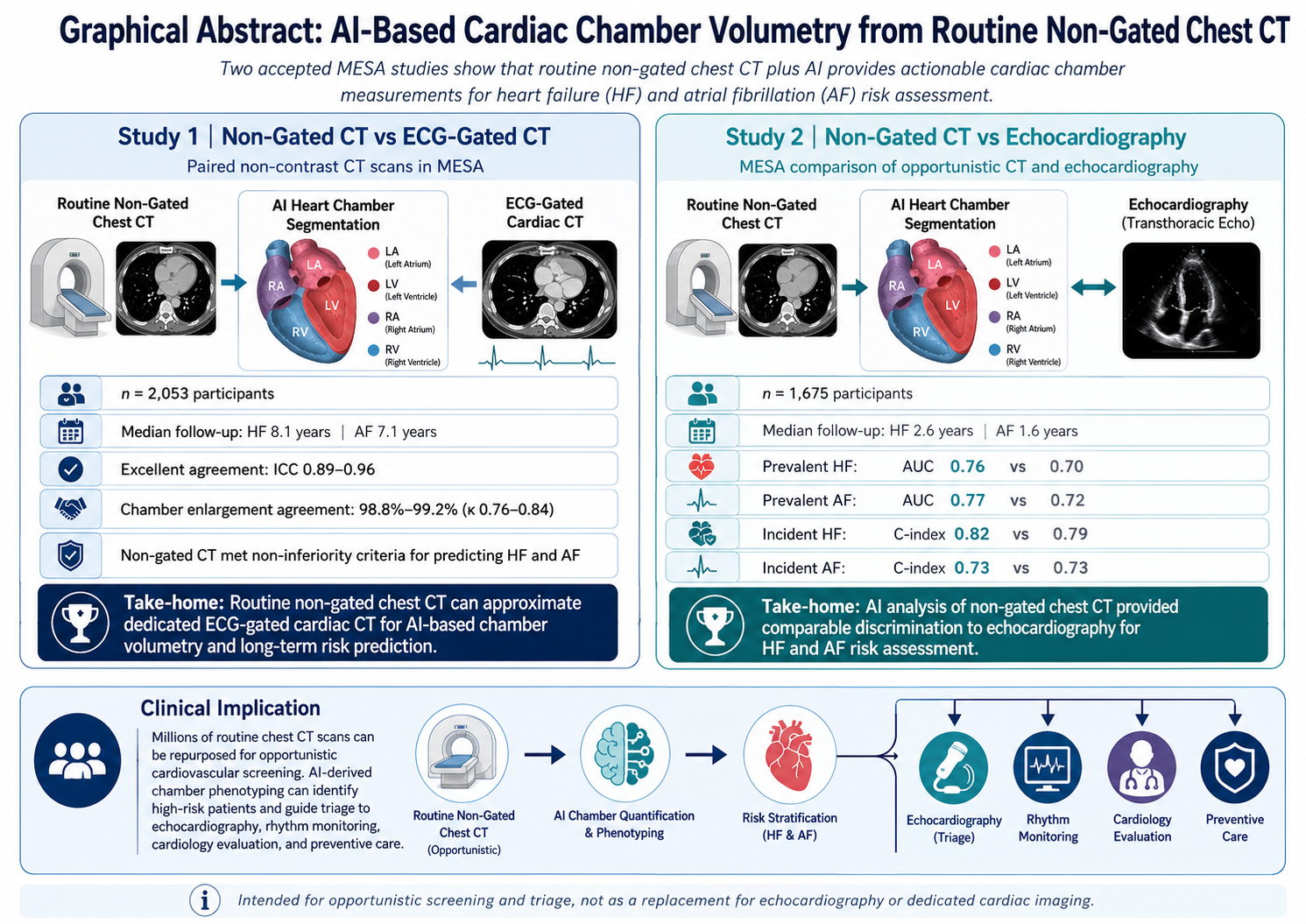
HOUSTON, TX, UNITED STATES, July 16, 2026 /EINPresswire.com/ -- HeartLung.AI announced the acceptance of two complementary studies in the American Journal of Preventive Cardiology demonstrating that artificial intelligence can extract clinically meaningful cardiac chamber measurements from routine non-gated, non-contrast chest CT and assess heart failure and atrial fibrillation risk with performance comparable to both dedicated ECG-gated cardiac CT and manually measured echocardiography.Most chest CT examinations are performed for non-cardiac indications such as lung cancer screening, chronic lung disease, infection, or trauma and are acquired without ECG gating. Using HeartLung.AI's FDA-cleared AutoChamber™ technology within the AI-CVD® platform, the two studies evaluated whether these widely available scans can provide reliable cardiac chamber phenotyping and identify patients at increased risk of heart failure and atrial fibrillation.
The first study analyzed paired non-gated and ECG-gated CT scans from 2,053 MESA participants and compared the differences with normal rescan variability in 5,749 participants. Non-gated CT showed excellent agreement with ECG-gated CT and non-inferior prediction of incident heart failure and atrial fibrillation.
The second study compared AI-derived CT measurements with standardized core-laboratory echocardiography in 1,675 MESA participants. Although absolute volumes were higher on CT, as expected, CT provided comparable or better discrimination for prevalent and incident heart failure and atrial fibrillation.
“Together, these studies show that a routine chest CT can identify structural patterns associated with future heart failure and atrial fibrillation, with performance comparable to dedicated cardiac CT and echocardiography. This is not a substitute for diagnostic testing - it is a scalable way to find high-risk patients earlier and direct them to the right next step.”
- Morteza Naghavi, M.D., founder and CEO of HeartLung.AI and senior author
Why the findings matter
Approximately 20 million chest CT examinations are performed annually in the United States. These studies show that scans already acquired for other indications can yield actionable information about chamber enlargement, left ventricular mass, and chamber balance without contrast, ECG gating, or a separate acquisition.
The opportunity is earlier triage rather than stand-alone diagnosis. Abnormal findings could prompt echocardiography, rhythm monitoring, cardiovascular evaluation, or more intensive risk-factor management. The approach also complements coronary calcium and the broader AI-CVD strategy of extracting multiple biomarkers from one eligible CT scan.
Clinical context and limitations
Opportunistic CT-based chamber volumetry is not intended to replace echocardiography, cardiac MRI, or a dedicated diagnostic workup. Echocardiography remains essential for dynamic assessment of ejection fraction, valves, wall motion, and hemodynamics. Broader reference ranges, longer follow-up, external validation, prospective implementation studies, and cost-effectiveness analyses are still needed.
Publication details
Publication details
Both manuscripts were accepted July 1, 2026, by the American Journal of Preventive Cardiology: Mirjalili SR, et al., article 101732, DOI 10.1016/j.ajpc.2026.101732; and Mirjalili SR, et al., article 101731, DOI 10.1016/j.ajpc.2026.101731.
1. https://www.sciencedirect.com/science/article/pii/S2666667726003077
2. https://www.sciencedirect.com/science/article/pii/S2666667726003065
About HeartLung.AI
HeartLung.AI is a health-tech company pioneering AI-driven preventive imaging for early detection of cardiovascular disease, lung cancer, COPD, osteoporosis, fatty liver disease, myosteatosis, and other cardiometabolic conditions detectable on routine medical imaging. Its FDA-cleared flagship platform, AI-CVD®, transforms CT scans into comprehensive preventive health assessments by automatically quantifying coronary artery calcium, aortic and valvular calcification, cardiac chamber size, aorta and pulmonary artery size, epicardial and visceral fat, liver density, lung density, bone mineral density, and muscle-fat composition.
HeartLung’s coronary calcium solutions include AutoCAC™, an automated Agatston-1.0 CAC scoring platform, and AI-CAC™ / Agatston-2.0, an AI-native approach designed to detect and quantify early, subtle, or lower-burden coronary calcium that may be underestimated by conventional scoring. HeartLung has also received FDA Breakthrough Device Designation and Marketing Authorization for AutoChamber™ and FDA 510(k) clearance for AutoBMD™, a DEXA-equivalent CT-based opportunistic osteoporosis screening solution.
A major part of HeartLung’s platform is AutoLung AI™, an AI-enabled lung cancer assessment tool that combines whole-scan analysis, nodule-centric assessment, and a safety-net approach for nodules ≥6 mm. AutoLung is designed for both lung cancer screening LDCT and opportunistic lung cancer assessment on routine chest CT and CAC scans, addressing a large unmet need because millions of thoracic CT scans are performed each year outside formal lung cancer screening programs. In internal validation, AutoLung demonstrated performance beyond conventional approaches such as Lung-RADS, PLCOm2012, and nodule size, including in non-screening CT and never-smoker populations.
HeartLung is also expanding beyond CT with upcoming AI-CXR and AI-ECG capabilities to identify elevated cardiovascular risk from routine chest X-rays and ECGs, including when traditional risk-factor data are incomplete or unavailable. These tools support HeartLung’s broader vision of using widely available clinical tests to uncover hidden cardiovascular and lung cancer risk earlier.
HeartLung requires no new hardware or local software installation. Hospitals and imaging centers can connect PACS to the HeartLung.AI cloud or manually upload scans and receive AI-generated DICOM and PDF reports. HeartLung is also preparing to launch the HeartLung Scan, a direct-to-consumer service and mobile app designed to help individuals find participating imaging centers, book preventive scans, and receive advanced AI-powered reports directly in their pocket.
Marlon Montes
HeartLung Technologies
+16504147303 ext.
email us here
Visit us on social media:
LinkedIn
X
Legal Disclaimer:
EIN Presswire provides this news content "as is" without warranty of any kind. We do not accept any responsibility or liability for the accuracy, content, images, videos, licenses, completeness, legality, or reliability of the information contained in this article. If you have any complaints or copyright issues related to this article, kindly contact the author above.
