

Imec & Diraq Demo First Coherent Operation of 8 Silicon MOS Spin Qubits Made in 300mm CMOS-Compatible Foundry Process
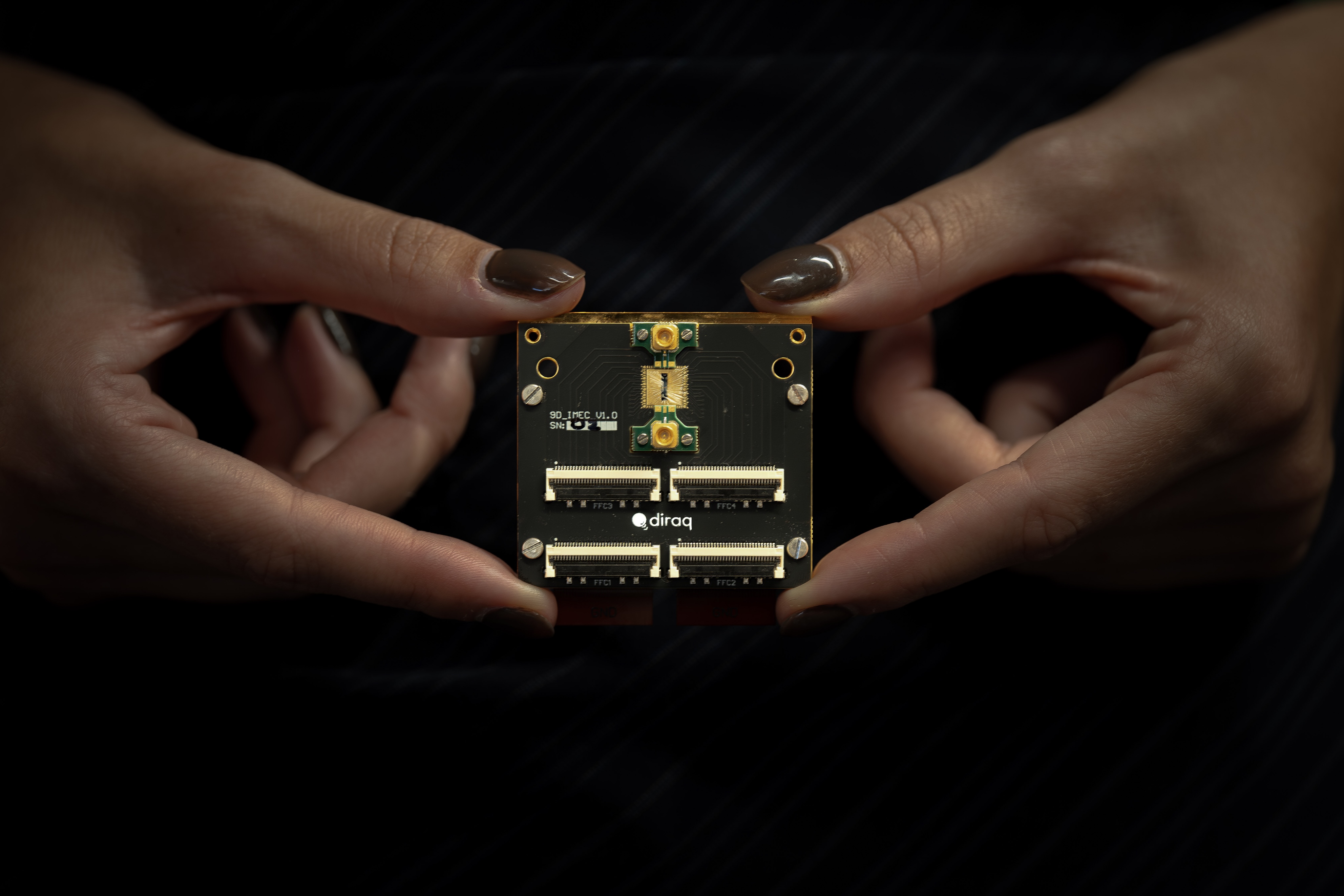
Picture of the silicon spin qubit processor measured by Diraq
Result shows that industrial semiconductor manufacturing can support the scaling of silicon quantum processors beyond the two-qubit regime.
SYDNEY, AUSTRALIA, July 13, 2026 /EINPresswire.com/ -- SUMMARY-Imec and Diraq have demonstrated the coherent operation and readout of an eight-qubit silicon MOS spin-qubit array fabricated on imec’s 300mm CMOS-compatible manufacturing platform, marking a significant milestone in scalable quantum computing.
-The result shows that industrial semiconductor manufacturing can support quantum processors beyond individual and two-qubit devices, bringing the industry closer to large-scale, manufacturable quantum computers.
-The achievement demonstrates that industrial 300mm CMOS-compatible manufacturing can support increasingly complex quantum systems while maintaining the coherence and controllability needed for future large-scale silicon-based quantum processors.
Imec, a world-leading research and innovation hub for advanced semiconductor technologies, and Diraq, a pioneer of silicon-based quantum computing, today announce they have demonstrated the coherent operation and readout of an eight silicon MOS spin-qubit array designed and fabricated on imec's advanced 300mm spin-qubit technology platform using a CMOS-compatible process. The results, published in a Nature Communications paper, mark an important step toward scalable quantum processors manufactured with the same industrial technologies used to produce today's most advanced semiconductor chips.
Silicon spin qubits are widely regarded as one of the most promising pathways to large-scale quantum computing because they can exploit the infrastructure, supply chains and manufacturing expertise already developed by the semiconductor industry. The work of this paper builds on imec and Diraq’s earlier demonstration, in a 2025 Nature paper, showing that industrially manufactured silicon spin qubits can achieve fidelity levels required for quantum error correction. While that result established the viability of individual and two-qubit building blocks, today’s work extends this and demonstrates that imec’s process can be scaled to larger arrays: an eight-qubit linear array was demonstrated, maintaining the coherence and controllability required for future large-scale quantum computers. In addition, scaling the readout architecture for this larger array does not require a significant increase in sensor count, wiring density, or thermal load; this type of favorable scaling ratio points toward arrays that remain highly compact as they grow, which is required for large scale quantum processors.
The eight-qubit devices were fabricated on imec's 300mm silicon spin-qubit platform, which leverages CMOS-compatible manufacturing technology developed over nearly a decade of process optimization and engineering, bridging the gap between laboratory demonstrations and manufacturable quantum technologies.
"The future of quantum computing depends not only on qubit quality but also on the ability to manufacture increasingly complex quantum processors with the reproducibility, yield and scale of the semiconductor industry," said Kristiaan De Greve, fellow and program director quantum computing at imec. "This result demonstrates that industrial 300mm CMOS-compatible manufacturing can support quantum systems beyond isolated qubit pairs. By combining imec’s advanced semiconductor process technology with quantum device engineering, we are taking important steps toward realizing scalable silicon-based quantum processors."
"This is what an industrial pathway to quantum computing looks like," said Andrew Dzurak, Founder and CEO of Diraq. "Nine months ago, we showed the world that silicon MOS qubits could be fabricated reliably using imec’s 300 mm CMOS platform technology. Today, imec has scaled and Diraq has tested the size of the array using exactly the same process, with no compromise in coherence. This is the cadence we need to reach utility scale, and it is the type of cadence we expect to keep.”
About imec
Imec is a world-leading research and innovation hub in advanced semiconductor technologies. Leveraging its state-of-the-art R&D infrastructure and the expertise of over 6,500 employees, imec drives innovation in semiconductor and system scaling, artificial intelligence, silicon photonics, connectivity, and sensing.
Imec’s advanced research powers breakthroughs across a wide range of industries, including computing, health, automotive, industry, consumer electronics, aerospace and security. Through IC-Link, imec delivers customized solutions, from concept to full-scale manufacturing, to meet the most advanced design and production needs. Through imec.ventures, imec creates, co-creates new ventures, and supports existing semiconductor deep-tech companies to scale-up.
Imec collaborates with global leaders across the semiconductor value chain, as well as with technology companies, start-ups, academia, and research institutions in Flanders and worldwide. Headquartered in Leuven, Belgium, imec has research facilities in Belgium, across Europe, the USA and the GCC region, and representation on three continents. In 2025, imec reported revenues of €1.2 billion.
For more information, visit www.imec-int.com
The imec group holds a global trademark portfolio, including word marks and combined figurative registered and unregistered trademarks, across national, regional, and international territories. Its lawful use requires prior written consent of IMEC in compliance with the IMEC branding guidelines, which may be updated periodically. The latest version is available upon written request.
Contact:
Jade Liu, international press communications (Americas, GCC, Asia-Pacific) // T +32 16 28 16 93 // M +32 495 71 74 52 // Jade.Liu@imec.be
Linda Wetzel, international press communications (Europe) // T +32 479 86 16 73 // linda.wetzel@imec.be
About Diraq
Diraq is commercializing quantum computing with a silicon-based approach that uses existing CMOS processes. By utilizing the same manufacturing methods that produce today’s semiconductor components, Diraq is pioneering a faster, more economic road to commercial-scale quantum computing. The company’s proprietary ‘quantum dot’ technology is based on 20 years of research by founder Andrew Dzurak, designed to enable millions of qubits on a single chip, for powerful and scalable deployments. Diraq’s mission is to revolutionize quantum computing by unlocking the scale needed for useful commercial applications. Diraq was founded in Sydney, Australia, where its R&D facilities are based. The company's U.S. headquarters are in Palo Alto, California, with additional offices in Los Angeles and Chicago. To learn more, visit www.diraq.com, or follow Diraq on LinkedIn, YouTube, Substack, and X.
Contact:
media@diraq.com
Hannah Sills
The Bulleit Group
email us here
Visit us on social media:
LinkedIn
YouTube
X
Other
Legal Disclaimer:
EIN Presswire provides this news content "as is" without warranty of any kind. We do not accept any responsibility or liability for the accuracy, content, images, videos, licenses, completeness, legality, or reliability of the information contained in this article. If you have any complaints or copyright issues related to this article, kindly contact the author above.
