
OpenYC Launches Digital Public Infrastructure for Five U.S. Cities — on the Week of America's 250th
Not OpenAI but OpenYC: public-good AI plus YC orchestration as democratically governed public infrastructure across NY, LA, Boston, Miami, Vegas.
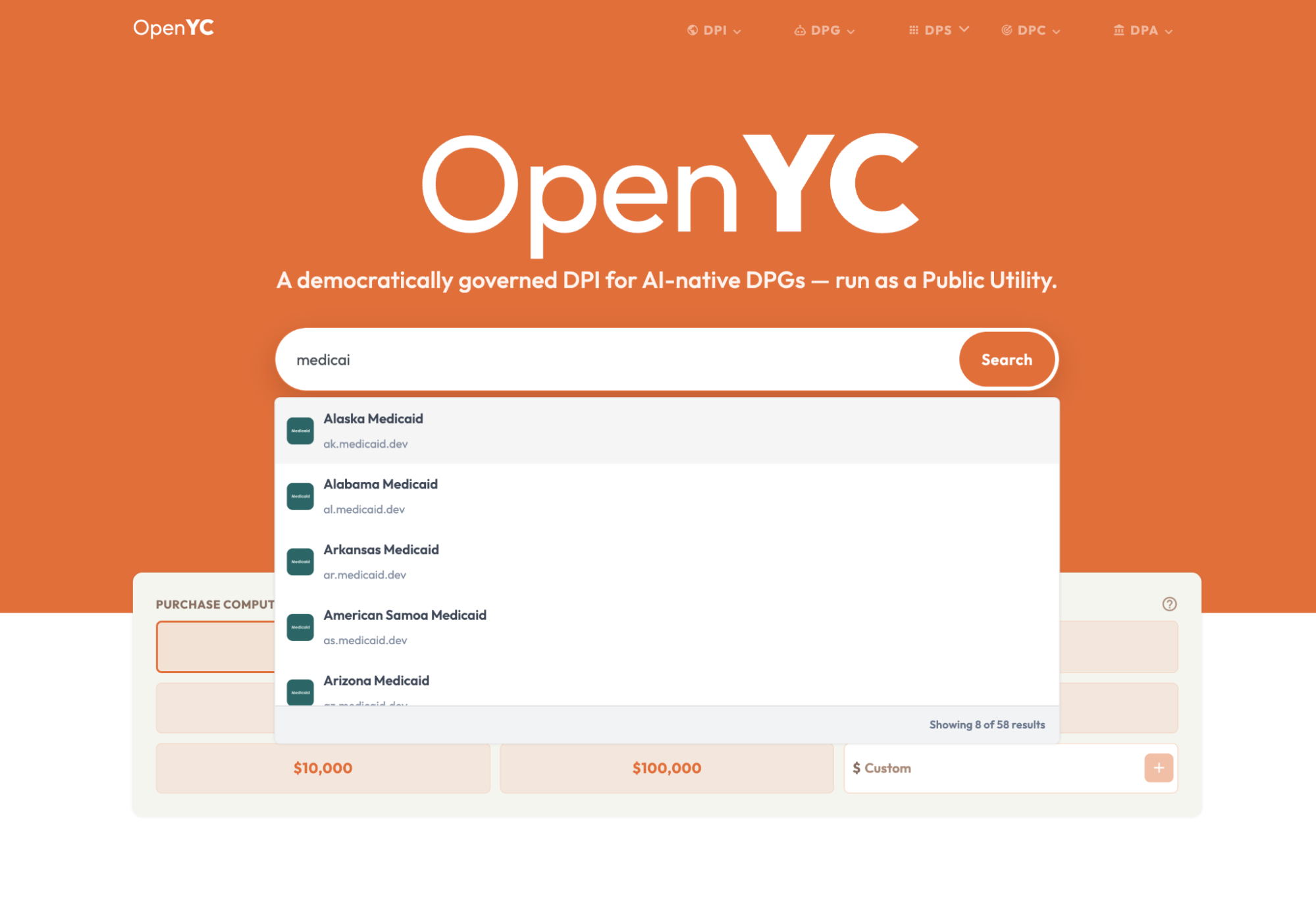
NY, UNITED STATES, July 1, 2026 /EINPresswire.com/ -- Two hundred and fifty years after this country declared that its promise belonged to everyone, OpenYC is setting out to make that promise literal. The tech industry promised AI would do awesome things for everyone — then switched up and just made itself richer and the rest of us poorer. OpenYC's answer launches this week in New York, ahead of America's 250th Independence Day — the first of five city-wide Digital Public Infrastructure (DPI) deployments, with Los Angeles, Boston, Miami, and Las Vegas following by year's end. Each is democratically governed public infrastructure that outputs AI-native Digital Public Goods (DPGs), with an agent copilot that drives users the shortest path from problem to verified outcome. The front door at openyc.org leads with its animated wordmark: OpenYC resolves to Open λᶜ — Open Lambda Codification — and a single search field that asks what one needs in plain language.Think of it the way someone thinks about roads versus the things that ride on them. The DPI is the public road — shared, governed, paid for once, open to everyone. The DPGs are the cargo: Medicare enrollment, a covered MRI, a CNA's first shift. The agent copilots are the drivers who know the route.
The opportunity, stated plainly:
The systems people depend on every day are bloated with middlemen, and the value those systems create has been bifurcated from legal tender. What if Y Combinator were a democratically governed DPI that output AI-native Digital Public Goods, with agent copilots guiding each user the shortest path from problem, to solution, to verified outcome? A "new, new deal" for America needs a kind of OpenAI plus a kind of YC — but one that actually helps people. OpenAI's public-good mission + the orchestration of YC = OpenYC. Not another lab racing to capture the upside. A public road, governed by the people who drive on it.
How a path works:
A person enters a plain-language request. OpenYC matches it to a curated program when one clears a confidence threshold, and creates one when none exists. It staffs the path with AI agents — and with human experts wherever judgment or a license is required — guides the person to a verified outcome, and verifies that outcome on a live audit trail anyone can inspect. Agents are non-deterministic by nature but bound by program and protocol, with risk-classified human-in-the-loop checkpoints: the highest-risk actions (prescribing a controlled substance, dispatching irreversible funds) always pause for a human, others are threshold-gated, and routine steps run automatically.
The five steps:
1. Define the problem
2. Codify the solution
3. Set up the program
4. Execute
5. Verify the outcome.
A few real journeys: "My mom takes five different pills and nobody's checking if they clash." / "I got my CNA license last month and I still haven't landed a single shift." / "I'm a night-shift nurse and I can't find anyone to cover my Saturday." / "My MRI got denied again and I have no idea why my insurance keeps saying no." And the everyday ones: help me get my mom on Medicare; a family that needs food assistance this month; a veteran who needs help finding work.
The Deal — five elements:
Problem (a system bloated with middlemen, value bifurcated from legal tender); Solution (an AI-native agent economy that routes people directly to the stakeholders who carry the outcome — with no advertiser and nothing to steer the agent toward, work priced from public wage data rather than padded by intermediaries); Players (everyone touched by a program or protocol; the five DPI cities are the live test); Financing (contracts with real settlement — low-friction, no-junk-fee rails); Expertise (Codify. Public Domain Agents (PDAs): the intent is one public AI per field that everyone can use rather than rent — codify.healthcare, codify.education). The work is staffed not by a vast anonymous swarm but by roughly a dozen built-in agent roles — a medical specialist, a pharmacy agent, a nurse coordinator, a care coordinator, a compliance agent, and the like — supplemented per deal by purpose-found specialists when a path needs them.
What's launching today:
The five U.S. deployments run at codify.nyc, codify.la, codify.boston, codify.miami, codify.vegas — the U.S. footprint within a 26-city global launch catalog.
The five U.S. cities are this year's focus; portals for additional catalog cities, including several international ones, are already provisioned and resolving. In each city the same set of public surfaces is exposed — one tenant, served through different surface repositories: the public-facing population surface (codify.<city>), the codification front door at the codify.<city> apex, the utility-and-economy surface where the public goods and agents are operated (app.codify.<city>), and governance and policy (gov.codify.<city>).
New York is live now — the deepest build, already standing up dozens of real city-agency portals: the fire department (fdny.codify.nyc), buildings (dob.codify.nyc), housing (hpd.codify.nyc), and transit (mta.codify.nyc) among 177 agency subprojects. Los Angeles, Boston, Miami, and Las Vegas are seeded and roll out through the end of 2026.
The first DPGs are already in service: Medicare.dev, Medicaid.dev, and Crohns.ai are all live.
Why this, from the founder:
OpenYC was built by Arion Hardison, whose father spent 30-plus years as a social-service worker. Hardison applied to Y Combinator and was not chosen — "gatekept by design" — and built OpenYC on a single principle: public good over personal gain. Quote: "We have a hammer to hit things, a ruler to measure things, and AI to codify things. But you can't just hand someone a hammer and a saw and say 'go for it' — every trade has its craftsmen, its best practices, its manuals and guides. That's the level of abstraction we have to put around AI to make it useful as a public utility." — Arion Hardison, founder, OpenYC
About OpenYC:
The front door to a democratically governed Digital Public Infrastructure: describe what is need edin plain language, and agent copilots staff and drive the path to a verified outcome. One doesn't apply to an accelerator here — they stand one up, instantiated for any vertical or locale. Operated as a public utility rather than rented back to the people it serves.
Disclaimer: OpenYC is an independent initiative. It is not affiliated with OpenAI or Y Combinator, and it is not an official U.S. government program or any of its agencies.
λ — A Y Combinator is a fixed-point combinator (Y f = f(Y f)). OpenYC makes YCs, so what it emits is a self-referential unit — a λ, OpenYC's mark. The name decodes as Open Lambda Codification (λᶜ): intent (λ — the seed, the first of a deal's five elements) raised to the power of codification (C). Public Good over Capital Gains.
Learn more at https://openyc.org
Arion Hardison
OpenYC
ach@openyc.org
Legal Disclaimer:
EIN Presswire provides this news content "as is" without warranty of any kind. We do not accept any responsibility or liability for the accuracy, content, images, videos, licenses, completeness, legality, or reliability of the information contained in this article. If you have any complaints or copyright issues related to this article, kindly contact the author above.
