

Your daily news update on Montserrat
Provided by AGP
Tarrant County Businesses Add 17.4% in Value

Tarrant County Businesses Add 17.4% in Value
O'Connor discusses how Tarrant County businesses add 17.4% in value.
FORT WORTH, TX, UNITED STATES, May 7, 2026 /EINPresswire.com/ --Home to Fort Worth, Tarrant County is the second pillar of the DFW metroplex. While Dallas County may have more money, Tarrant is the bigger of the two and is only behind Harris when it comes to size. While the likes of Denton and Collin counties have become hot suburbs, Tarrant remains one of the top counties in Texas. Like its fellow metroplex counties, Tarrant has seen its property value double in the past decade. With DFW being one of the hottest places to live and work in the nation, these values are going to rise in the coming years.
Tarrant Homes Add $3 Billion in Value in 2026
Just as it did in 2025, the value of residential real estate in Tarrant County increased by 1.6%. This was well behind the 4% increase seen in Dallas County. The majority of residential value in Tarrant came from homes worth between $250,000 and $500,000, with a total of $108.15 billion following an increase of 1.35%. Homes worth under $250,000 were in second place with a total of $35.18 billion, though they only grew by 0.3%. Residences valued from $500,000 to $750,000 added 1.8% to total $32.62 billion. Homes worth over $1.5 million soared 6.7% for an overall final number of $13.09 billion.
Tarrant County stayed close to its roots when it came to the size of houses, and most residential value came from small or modest homes. Those under 2,000 square feet jumped 3% in value to reach $85.97 billion, while those between 2,000 and 3,999 square feet totaled $99.37 billion following an increase of 0.4%. Residences between 4,000 and 5,999 square feet added 0.9% to total $21.73 billion. Jumping 4.9%, homes between 6,000 and 7,999 square feet totaled $2.80 billion, while true mansions grew 2.7% to $4.69 billion.
When looked at by age of construction, Tarrant skewed slightly older than the other DFW counties. 37%, or $75.40 billion in value, was built in the boom period from 2001 to 2020, following a slight increase of 0.2%. Edging up 0.3%, homes from 1981 to 2000 combined for a final tally of $60.87 billion. Climbing 0.4% each, homes from 1961 to 1980, and the oldest homes in the county reached $30.99 billion and $25.85 billion, respectively. New construction added 3.4%, for a total of $14.37 billion. Raw land nearly tripled in value to a total of $3.09 billion.
34% of Tarrant Homes are Overvalued
In 2025, only 19% of homes were estimated to have been overvalued by the Tarrant County Appraisal District (TAD). In 2026, it was estimated that 34% of homes were overvalued. While these numbers are more conservative than many other counties, it still represents a higher and unrealistic burden for a third of all homeowners. Unequal appraisal is one of the prime justifications for a property tax appeal, and many homeowners should explore this possibility before the May 15 deadline.
Commercial Properties Surge 17.4%
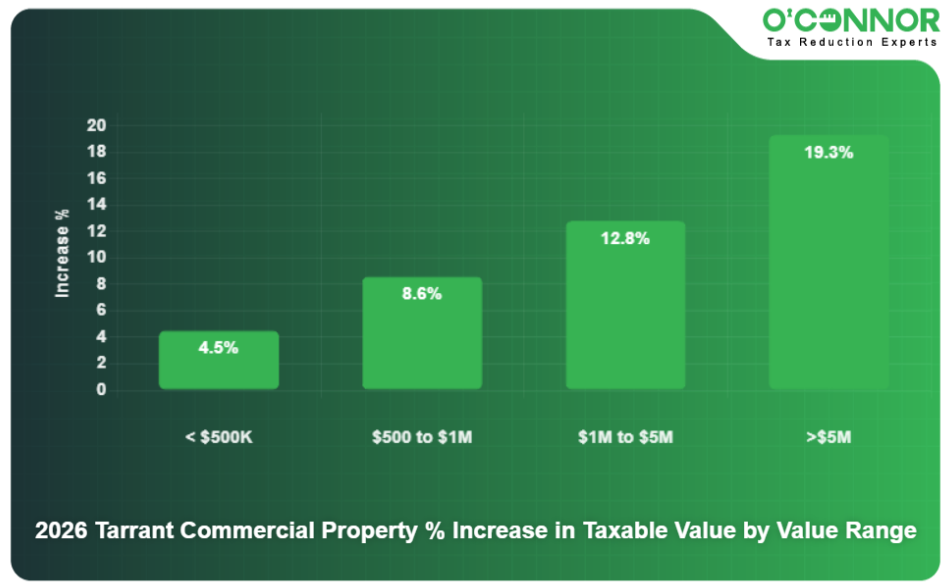
2025 saw businesses across Tarrant County add over 25% to their total value. While not to the extreme, commercial property did grow by 17.4%, going from $82.93 billion to $97.38 billion. This was primarily driven by the most expensive businesses in the county, which added 19.3%, reaching a total of $77.21 billion. Those worth between $1 million and $5 million added 12.8%, totaling $13.87 billion. Though each totaled only around $3 billion, the two smallest categories saw solid increases.
Like the rest of the metroplex, the largest commercial property type was apartments, which totaled $45.33 billion following a huge leap of 23.8%. Raw land was in second place with $24.55 billion, following an increase of 4%. Offices increased by 11.6% to total $11.47 billion, while retail surged 21.4% to reach $8.11 billion. Hotels saw a massive increase of 46.4%, which translated into a final total of $6.12 billion.
Commercial property in Tarrant County saw a stronger bend toward newer construction than homes did. Soaring 47.2%, new construction totaled $10.50 billion, roughly 11% of the whole. Growing by 13.9%, those built from 2001 to 2020 accounted for $36.03 billion, while those from 1981 to 2000 increased 16.9% to $24.86 billion. Businesses built from 1961 to 1980 added 18.2% to their total, which ended up being $11.79 billion. Even the oldest properties managed to grow by 12.9%.
Commercial Real Estate Lost 7% of Value Nationwide
Businesses in the Fort Worth region have added tens of billions to their value in the past few years, but the same cannot be said for the rest of the nation. Analysis by the Federal Reserve of St. Louis (FRED) showed that commercial property across the nation has generally declined by around 7% in the past few years. This is in stark contrast to the 17.4% increase levied by TAD for commercial properties in Tarrant County. While Texas, and the DFW area in particular, have seen strong economic growth, the study should give business owners pause. If they feel their business is overassessed, then a property tax protest should be filed promptly.
Apartments Add $8.71 Billion in Value
Apartments had already surged 25% in 2025, so the increase of 23.8% in 2026 represented a large increase in value. Adding $8.71 billion, the final total for apartments was $45.33 billion. Apartments saw some recency bias, with $7.74 billion coming from new construction after a large increase of 49.9%. Those built from 2001 to 2020 added 17.8%, reaching a final value of $16.63 billion, while those from 1981 to 2000 added 19.1% to total $13.64 billion. Land set aside for apartments skyrocketed by 430.1%, for a total of $135.25 million.
TAD classified multifamily housing into four subtypes. Low-rise apartments added 23.5% to total $40.10 billion. High-rise apartments grew 24.4% to $4.82 billion. Multifamily surged by 390.8%, reaching $143.54 million, while student housing increased 6.2% to $267.86 million.
Offices Add 11.6%
Due to changing economic times, the value of offices has generally not grown as fast as other property types. Still, offices in Fort Worth and the surrounding area surged 11.6%, totaling $11.47 billion. $4.67 billion of the total came from those built from 2001 to 2020, following a bump of 11.4%. New construction soared 45.1%, achieving a final sum of $783.19 million. 32% of all value came from those constructed between 1981 and 2000, which saw an uptick of 7.9%. Even those from 1961 to 1980 experienced an increase of 8.9%, totaling $1.55 billion.
TAD used three subtypes for offices. Low-rise offices increased 8.3% to $5.63 billion, while high-rise offices added 18.6% to total $3.11 billion. Medical offices spiked 11.1% to reach a final tally of $2.73 billion.
Retail Jumps 21.4%
Retail added over 31% to its value in 2025, and 2026 was another big boost with 21.4%. This pushed the final total to $8.11 billion. The largest source of value was stores built from 2001 to 2020, which accounted for $3.08 billion, following a sharp increase of 16.3%. Those built from 1981 to 2000 were close behind with $2.44 billion, following a jump of 24.4%. Those constructed between 1961 and 1980 also got a big boost of 22.7%, which resulted in a final total of $978.90 million. New construction added 42.8%, which translated to a final sum of $361.39 million.
Strip centers continued their tradition as the top retail property in Tarrant County, totaling $6.67 billion following an increase of 21%. Retail stores came in second with $900.42 million, thanks to a bump of 21.4%. Malls totaled $419.48 million, while neighborhood shopping centers accounted for $112.77 million. These two properties increased 23.6% and 37.8%, respectively.
Warehouses Increase by 15%
Warehouses have a small footprint in the Fort Worth area, achieving a total of $1.80 billion following a strong increase of 15%. $756.67 million was built from 2001 to 2020, while $461.76 million came from between 1981 and 2000. New construction made an impact with an increase of 18%, which resulted in a final total of $313.27 million. Warehouses built from 1961 to 1980 increased 12.9% to $237.41 million, while the oldest warehouses increased by 12%.
About O'Connor:
O’Connor is one of the largest property tax consulting firms, representing 185,000 clients in 49 states and Canada, handling about 295,000 protests in 2024, with residential property tax reduction services in Texas, Illinois, Georgia, and New York. O’Connor’s possesses the resources and market expertise in the areas of property tax, cost segregation, commercial and residential real estate appraisals. The firm was founded in 1974 and employs a team of 1,000 worldwide. O’Connor’s core focus is enriching the lives of property owners through cost effective tax reduction.
Property owners interested in assistance appealing their assessment can enroll in O’Connor’s Property Tax Protection Program ™. There is no upfront fee, or any fee unless we reduce your property taxes, and easy online enrollment only takes 2 to 3 minutes.
Patrick O'Connor, President
O'Connor
+1 713-375-4128
email us here
Visit us on social media:
LinkedIn
Instagram
Facebook
YouTube
TikTok
X
Legal Disclaimer:
EIN Presswire provides this news content "as is" without warranty of any kind. We do not accept any responsibility or liability for the accuracy, content, images, videos, licenses, completeness, legality, or reliability of the information contained in this article. If you have any complaints or copyright issues related to this article, kindly contact the author above.
